Final Cromwell glamour shots. 1/76 Airfix kit with some Value Gear stowage. Canadian 1943 Victory Nickel for scale.
Showing posts with label Airfix. Show all posts
Sunday, September 11, 2022
Wednesday, February 3, 2021
Airfix 1/72 Spitfire Vc
The new Airfix 1/72 Spitfire Vc arrived a few weeks ago from the UK and I started it right away. Really enjoying it. But all that cockpit detail gone... Still unsure if it will end up as a USS Wasp Malta delivery or a 417 Squadron RCAF desert bird.
Sunday, July 14, 2019
Wednesday, March 16, 2016
424 Squadron Mustang in 1/72
I've only wanted to build an RCAF 424 Squadron Mustang 4 with the tiger badge since about 1982. In 2016, I finally made it happen. This is the Airfix kit mostly out of the box with Leading Edge decals.
424 Squadron was an Auxiliary Fighter Squadron that flew from Hamilton, Ontario, post World War Two. The tiger badge on the side was adapted from the CFL Hamilton Tigercats logo. Gunze Mr. Colour H8 Silver for the natural metal and Tamiya Flat Aluminum for the rudder. The spinner is Gunze Chrome. This is my least favorite of the new tool Airfix kits that I've built, but it's still pretty nice and a great value. (The black and white photo is courtesy of the Canada. Dept. of National Defence/Library and Archives Canada.)
Monday, September 7, 2015
Airfix Tomahawk and Gear Legs
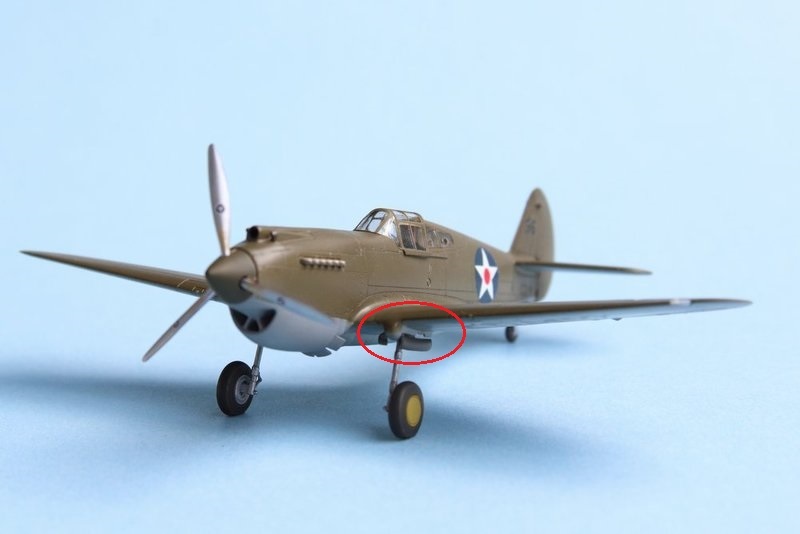
As I stated in the P-40 gallery, something didn't look right to me when I compared the photos of my model with the photos of the subject. There was too much space between the wheel and the landing gear door. I never actually noticed this on the model, but it jumped out to me in the photos. Fellow modeler Scott Hemsley and I discussed the issue and Scott pointed out the problem. It appears that Airfix got the gear legs a little long. Notice the collar in the red circle on my model?
Notice its location on the real thing...in line with the bottom of the gear doors.
Of course, my first thought is that I did something wrong, but looking around the web, it seems like this issue is featured on almost every model. So next time I'll shorten the upper part of the leg, confirm that the collar is in the right location, and see if it solves the problem.
Notice its location on the real thing...in line with the bottom of the gear doors.
![]() |
| (Photo courtesy of the Carl Vincent Collection.) |
Of course, my first thought is that I did something wrong, but looking around the web, it seems like this issue is featured on almost every model. So next time I'll shorten the upper part of the leg, confirm that the collar is in the right location, and see if it solves the problem.
Friday, September 4, 2015
Icelandic P-40C in 1/72
I started the Airfix 1/72 Hawk 81A-2 about the time it hit the U.S. shores (December 2012!!), planning to build an RCAF Tomahawk. I had it all together by mid-month... and then it sat... and sat. AMS got the better of me and I couldn't decide which RCAF Tomahawk to build. (Or so I deluded myself into thinking...)
This last May, my local model club started looking for models to put in a "Battle of the Atlantic" display at the Museum of Flight. Remembering the mostly built but unpainted Tomahawk, I volunteered to build a USAAF P-40C. Why a USAAF P-40 in the Battle of the Atlantic?
In July 1941, the 33 Pursit Squadron loaded its P-40Cs on the USS Wasp (CV-7) for delivery to Iceland. Even though the U.S. had yet to enter the war, they had agreed to provide fighter cover for Iceland to allow the RAF fighter squadron on duty to return to England. The U.S. had important weather stations on the island and were concerned that the country would fall into Nazi hands and be used as a stepping stone to invade North America. On August 6, the P-40s were flown off the deck of the Wasp and landed at Kaldadarnes Airfield, near Reykjavík. On the morning of August 14, 1942, a Northrop N-3PB Nomad of No. 330 Squadron (Norwegian) located a German Focke-Wulf Fw-200 Condor maritime patrol bomber which was conducting overflights of Iceland. What happened next is the source of some confusion; either Lieutenant Joseph Shaffer, flying a P-40C, shot down the Condor or shared in the kill with two P-38s of 27th Fighter Squadron. (I'm sure the story depends on which Squadron is asked!) Oddly, in some accounts, Lt. Shaffer is flying a P-39. (Lt. Shaffer did shoot down a JU-88 while flying a P-39 out of Iceland on October 14, 1942.) Sadly, I could find no record of which P-40C Lt. Schaffer was flying on August 14, 1942, so this P-40C became my subject:
The kit has few vices. Sure, the wing to fuselage joint needed a little filler. Sure, the wing guns are liable to be knocked off. Most of the panel lines are fine for my purposes, but even I have to admit that the lines on the vertical fin are too heavy. Sadly, the canopy is too high, but I didn't replace it this time. (I didn't notice this until I was compiling this post, but it appears Airfix got the landing gear struts too long on the kit. Compare the sit of the prototype with the photos of my model. Looking at other Tomahawk shots, I think the collars that are below the landing gear doors on my model, should end in line with the doors. Next time I build this kit, I'll shorten the struts a little.) Overall, I enjoyed building it and it makes a nice model.
Paint is Tamiya Neutral Grey spray can for the lower surfaces and Mr. Color Olive Drab on top. Notice I even got the Maroon on the back of the prop! Decals are mostly Xtradecal but the 36 on the tail is from TwoBobs and the prop logos came from the kit. The final coat is from a Testors Acryl jar marked flat but it is more of a semi-gloss.
I ran out of time to replace the gun barrels and to weather it, but I'm reasonably happy with the final product. It is certainly an improvement over the Blitz Spitfire. (I do, however, need to read up on model photography. Sorry the depth of field is lacking.) Even a dyed -n-the-wool RCAF fan has to admit this is a really attractive scheme and it suits the Tomahawk!
On Thursday night, the model was ensconced in the Northwest Scale Modelers's display case at the Museum of Flight for the "Battle of the Atlantic" display. Thanks to the display producers for allowing me to include my model and thanks to club member Don Conrad for the photos of the display.
Tuesday, August 18, 2015
Blitz'a'Spitfire
So, I spent Sunday and Monday Blitzing a Spitfire. For those not in the know, a Blitzbau is a speed build held a couple of times a year over on the Unofficial Airfix Modelers Forum. The modeler has to start, and complete, a kit either within 24 hours straight, or two 12 hour sessions on two successive days. I, of course, choose the two 12 hour sessions. Shockingly, I actually finished.
The poor subject chosen for this excise was the recent Airfix Spitfire IX. I built it straight out of the box. Yep, I didn't install seat belts. I tried to be ok that it has no control column, no instrument panel, and open wheel wells. I didn't replacing the comfy chair with something prototypical. Sadly, in the name of speed, many, many historical inaccuracies were committed. (Wheels are the wrong style, no D-Day stripes, and the wheel bulges are still present on the top of the wings, etc.) Not to mention my canopy masking skills are ultra weak...
I'm glad I finished, but I'm kind of disappointed in the final model. That being said, I'm excited that I was actually able to finish a model in two days...my first for the year...and I'm pretty happy with my shade of pink as well. (The pink was a mix of Tamiya Flat White with a few drops of Tamiya pink added.)
The whole sorry tale...complete with a Seattle grunge history...can be found here.
The poor subject chosen for this excise was the recent Airfix Spitfire IX. I built it straight out of the box. Yep, I didn't install seat belts. I tried to be ok that it has no control column, no instrument panel, and open wheel wells. I didn't replacing the comfy chair with something prototypical. Sadly, in the name of speed, many, many historical inaccuracies were committed. (Wheels are the wrong style, no D-Day stripes, and the wheel bulges are still present on the top of the wings, etc.) Not to mention my canopy masking skills are ultra weak...
I'm glad I finished, but I'm kind of disappointed in the final model. That being said, I'm excited that I was actually able to finish a model in two days...my first for the year...and I'm pretty happy with my shade of pink as well. (The pink was a mix of Tamiya Flat White with a few drops of Tamiya pink added.)
The whole sorry tale...complete with a Seattle grunge history...can be found here.
Friday, January 9, 2015
Battle of the Barristers - There's a Hurricane Coming! Part 1
As Mr. Knights let the cat out of the bag the other day, he and I have entered into a 2015 Battle of the Barristers challenge build with Battle of Britain Hurricanes. Both of us will be building the recently issued Series 1 Airfix Hurricane Mk. I.
This is the second boxing of Airfix's fabric wing Hurricane. The kit is excellent and clearly the best Hurricane in 1/72 scale. The price point is a bit friendlier than the Series 2 version which also includes two decal options, the two bladed propellor, and other distinguishing features of the very early Hurricanes. (An extra sprue is included in the Series 2 Hurricane Mk. I to cater to these features.) Sadly, hopes for a metal wing version in 2015 appear to be dashed.
My plan is to build the kit mostly out of the box with replacement wheels...the Airfix kits have one too few spokes...and with Eduard's new fabric seat belts. I hope to get started this week and will be building the following aircraft:
L1851 was one of a few fabric wing Hurricanes on strength with 1 (F) Squadron RCAF. On August 18, 1940, the day after the Squadron became operational, Flight Lieutenant V. B.Corbett ran into a fuel browser with YO-U during a scramble at 14:30 hours at RAF Hornchurch. The results of the collision are illustrated in the photo above. (Photo courtesy of the Canada Department of National Defence/Library and Archives of Canada.)
As our Battle has a due date of December 31, 2015, not only should both David and I actually finish our Hurricanes, there is plenty of time for other barristers to join in our fun. Now if only I knew some other plastic-loving lawyers... (I'm looking at you August and Rick!)
This is the second boxing of Airfix's fabric wing Hurricane. The kit is excellent and clearly the best Hurricane in 1/72 scale. The price point is a bit friendlier than the Series 2 version which also includes two decal options, the two bladed propellor, and other distinguishing features of the very early Hurricanes. (An extra sprue is included in the Series 2 Hurricane Mk. I to cater to these features.) Sadly, hopes for a metal wing version in 2015 appear to be dashed.
My plan is to build the kit mostly out of the box with replacement wheels...the Airfix kits have one too few spokes...and with Eduard's new fabric seat belts. I hope to get started this week and will be building the following aircraft:
L1851 was one of a few fabric wing Hurricanes on strength with 1 (F) Squadron RCAF. On August 18, 1940, the day after the Squadron became operational, Flight Lieutenant V. B.Corbett ran into a fuel browser with YO-U during a scramble at 14:30 hours at RAF Hornchurch. The results of the collision are illustrated in the photo above. (Photo courtesy of the Canada Department of National Defence/Library and Archives of Canada.)
As our Battle has a due date of December 31, 2015, not only should both David and I actually finish our Hurricanes, there is plenty of time for other barristers to join in our fun. Now if only I knew some other plastic-loving lawyers... (I'm looking at you August and Rick!)
Sunday, November 13, 2011
Silver Primer
Besides visting some old airplanes, Mr. Knights forced me at X-Acto point to mask a Spitfire canopy. Fearing for my life, I did as requested. Returning home I had no choice but to throw some paint at the model. Picking up an old spray can of Tamiya AS-12, I started to spray only to find that there was very little paint left in the can. Spatter city. In the light of a new day, it isn't that bad. How about we call it a primer coat? A little Micromesh and I should be back in business. But this time, I'll load some Alclad in the airbrush...
Btw, this is the recent Airfix 1/72 Spitfire Mk. I that will be done up as a RCAF PR bird.
Tuesday, April 26, 2011
Airfix Kits

Title: Airfix Kits
Author: Trevor Pask
Publisher: Shire Library
In 2010 it seems like you couldn't go a month or two without a new book on Airfix hitting the shelves. This little book is simply a short history of Airfix. While not nearly as detailed as the Ward books, it is much better edited. There are many pictures of built kits and box art with lots of images from Airfix catalogues of the past. While there are some mentions of other Airfix related lines, the book solely covers Airfix's plastic kits.
Outside of the overly 70s cover...those are some dodgy haircuts...this is a really nice short history of the famous manufacturer.
Wednesday, January 26, 2011
Mauve Over
Friday, January 21, 2011
Thursday, August 19, 2010
Airfix Model World Magazine
It was announced yesterday that Key Publishing and Airfix have teamed up to start a new modeling magazine called Airfix Model World. It will be a 100 page monthly magazine that covers all genres of modeling, but with an aviation focus. The editor will be Glenn Sands and the first issue is set to debut in November 2010.
I find this a very interesting announcement. First off I can't believe the UK can subsidize the number of modeling magazines currently on the market, let alone a new title. That being said, I'm really excited to see what Airfix and Key can do and I do think there is room in the market for a good (professionally proofread) magazine that deals with all areas of modeling, and with Key's experience, production values, and distribution, along with the Airfix name, it might quickly become a major player in the market.
Tuesday, July 27, 2010
The Airfix Handbook

Title: The Airfix Handbook
Author: James May
Publisher: Conway Publishing
Ostensibly this slim volume is a tie in to the recent James May Toy Stories television show. However, it also functions as a short and sweet Airfix history and a good reason to never judge a book by its cover. (Ouch, is that ever a ugly cover!)
This small format hardback opens with a short history of Airfix drawing much inspiration from the Arthur Ward books, a short photographic tour of molding defects, some Roy Cross boxart, and a listing of all Spitfire kits issued by Airfix. We then have a modeling tip interlude by Chris Ellis on "10 things I wish I known when I was 10" before we get into Mr. May's project to create a 1/1 scale Airfix Spitfire. Obviously this project was better illustrated on the TV show, but it still an interesting read. Sprinkled throughout this section of the book is a short chapter on making a war movie out of Airfix tanks and a listing of the "10 Airfix kits every modeler should build." (I would quibble with the choices and suggest that most of the kits listed as honorable mentions (the 1/72 Pup, Lancaster, Vulcan, and Hurricane), should be on the main list, but isn't that what these kind of lists are for...disagreement?) Finally the book wraps up with a short build of the newer Spitfire XIX by Jonathan Mock, and, again drawn from the Ward books, a listing of Airfix kits issued year by year.
This is far from a definitive history of Airfix, but a quick and enjoyable read written by an Airfix fan. Fun.
P.S.: David, I looked in the whole book and never saw the phrase "Finish the Spitfire!"
Saturday, January 30, 2010
New Airfix Spitfire I?
Quite a few eyebrows were raised when Airfix announced their 2010 releases. First off who actually believed that we would see an injected Vickers Valiant from Airfix in 1/72? I am excited to see a new tooled Sabre, but disappointed that Airfix decided to repeat the hard winged F-86F/Sabre F.4 that Fujimi and Hobbycraft/Academy has previously kitted. (Just how happy would modelers across the world be if they instead has chosen the Korean War vintage F-86E/Sabre F.2 with the early slatted wing? Why, Airfix, why?) But maybe the oddest choice was a new tool Spitfire Mk.I. I know that 2010 is the 70th Anniversary of the Battle of Britain, but the Airfix Spitfire I released in 1980 is by far the most accurate Spitfire yet injected in plastic. The shape is pretty close to perfect, even if the detail is a little sparse, and the kit sports raised panel lines. I just hope the new Spitfire will share the same excellent shape of its predecessor and add more detail. First indications do look good. See the exploded view at around 25 seconds into Airfix's latest promo video. As the gear legs and doors are modeled together, I expect his is the new 1/72 Spitfire Mk.I. Cockpit detail looks much nicer then the seat and floor only of the recent Spitfire IX.
Friday, January 29, 2010
Hitler wants to build an Airfix Spitfire
As a general rule Hitler isn't the least bit funny, but this is hilarious!
Monday, December 21, 2009
Airfix SHAR and SHAR2
Buried under the snow, I found a nice surprise on my doorstep Saturday. The new Airfix Sea Harrier FRS.1 and F/A.2. The FRS.1 was immediately dispatched to the closet of no hope, but the F/A.2 was torn into with relish. I've been waiting years for a divine scale SHAR2 that was actually buildable and after spending too much money on resin conversions for the ESCI and Hasegawa Sea Harrier kits and the horrid Xtrakit rush job (and I passed on the Special Hobby kit which was the Xtrakit model with additional detail parts), I think this one will actually get built.
In typical current Airfix style it is a simple kit with deep panel lines, and decent moldings. The moldings are not quite as crisp as the recent Spitfires and Hawks and the plastic is softer. (Looking at the side of the box, these kits were molded in India, rather then China. I think that is a first for me...a model injected in India.) The good news is that all the F/A.2 mods are included. The longer fuselage with the new nose are captured well. The fin mounted pitot tube is included, even if it would be best to replace it with a length of metal for strength. The wings also have the necessary F/A.2 modifications.
Cockpit detail is a tub, instrument panel with combing, but no heads up display, a stick, a rather small seat and a World War two style pilot. (Oddly the Spitfires had a jet pilot...oh...oh...) I planned to fit an Aeroclub white metal Martin Baker Mk.10 seat, but there is not enough room in the tub and the white metal seat is way too tall. Decals are included for the panel and consoles as there is no raised details.
Weapons include Aden gun pods, the larger F/A.2 tanks, dual Sidewinders, AMRAAMs, and Sea Eagle anti-ship missiles. (I don't think the F/A.2 carried Sea Eagles.) Sadly, while the boxart shows the fuselage mounted AMRAAMs, the pylons are not included in the kit. Bummer.
The airbrake may be position opened or closed, and both open and closed auxiliary intake doors are provided. (These should be open on the ground, though most kits mold them closed) There is some detail inside the landing gear wells, but also some injection pins molded into the detail. Also included is a nice engine fan for the intake. The exhaust nozzles are molded in two pieces each and may be difficult to make look good if the fit is anything other then stellar. The main gear wheels are slightly over bulged for my taste. The canopy looks clear and well molded, if a little thick.
Decals are provided for 800, 801, and 899 Squadrons Fleet Air Arm in overall Medium Sea Grey. The decals look very well printed, and stenciling is included. As is becoming the norm, a full colour decal placement sheet is included for each option.
I'm too lazy to get some sprue shots, but you can find theme here and here.
Again, we have a nice buildable new kit from Airfix. Yes it could use a little resin and photoetch for additional detail, but for a reasonable price a nice base is provided out of the box. It is not state of the art, but it does seem like it will be a quick build. It surely beats the socks off the competition.
In typical current Airfix style it is a simple kit with deep panel lines, and decent moldings. The moldings are not quite as crisp as the recent Spitfires and Hawks and the plastic is softer. (Looking at the side of the box, these kits were molded in India, rather then China. I think that is a first for me...a model injected in India.) The good news is that all the F/A.2 mods are included. The longer fuselage with the new nose are captured well. The fin mounted pitot tube is included, even if it would be best to replace it with a length of metal for strength. The wings also have the necessary F/A.2 modifications.
Cockpit detail is a tub, instrument panel with combing, but no heads up display, a stick, a rather small seat and a World War two style pilot. (Oddly the Spitfires had a jet pilot...oh...oh...) I planned to fit an Aeroclub white metal Martin Baker Mk.10 seat, but there is not enough room in the tub and the white metal seat is way too tall. Decals are included for the panel and consoles as there is no raised details.
Weapons include Aden gun pods, the larger F/A.2 tanks, dual Sidewinders, AMRAAMs, and Sea Eagle anti-ship missiles. (I don't think the F/A.2 carried Sea Eagles.) Sadly, while the boxart shows the fuselage mounted AMRAAMs, the pylons are not included in the kit. Bummer.
The airbrake may be position opened or closed, and both open and closed auxiliary intake doors are provided. (These should be open on the ground, though most kits mold them closed) There is some detail inside the landing gear wells, but also some injection pins molded into the detail. Also included is a nice engine fan for the intake. The exhaust nozzles are molded in two pieces each and may be difficult to make look good if the fit is anything other then stellar. The main gear wheels are slightly over bulged for my taste. The canopy looks clear and well molded, if a little thick.
Decals are provided for 800, 801, and 899 Squadrons Fleet Air Arm in overall Medium Sea Grey. The decals look very well printed, and stenciling is included. As is becoming the norm, a full colour decal placement sheet is included for each option.
I'm too lazy to get some sprue shots, but you can find theme here and here.
Again, we have a nice buildable new kit from Airfix. Yes it could use a little resin and photoetch for additional detail, but for a reasonable price a nice base is provided out of the box. It is not state of the art, but it does seem like it will be a quick build. It surely beats the socks off the competition.
Saturday, November 7, 2009
James May Toy Stories - Airfix!
James May of Top Gear fame recently did a whole episode of his new Toy Stories TV show on Airfix and he even created a 1:1 scale Spitfire kit. Here is the full episode. Sit back and enjoy, it is great fun. It is nice to see modeling, and Airfix, get some TV coverage, even if it was only in the UK.
P.S.: On Thursday I got two copies of the brand new tool Airfix 1/72 Spitfire IX. Look for a review shortly.
Tuesday, August 4, 2009
Airfix 1/72 Spitfire PR.XIX

Last Thursday a small box was left on my doorstep with an English postmark. Within it contained two of kits I had been eagerly awaiting, the new Airfix Spitfire XIX and BAe Hawk, both in the divine scale, of course.
While there have been a few cracks at the Spitfire XIX in 1/72, all have left something to be desired. The MPM kit is from the early days of short run models and there is more flash then kit on the sprues. The Academy kit is boxed as a Spitfire XIV, but looks like a Spitfire on steroids, with a multitude of shape problems and a general bloated attitude. The Fujimi Griffon Spitfire family was the best of the bunch, but has a five piece fuselage, five piece wings, and rather poor fit. How does the Airfix kit stack up?
First off the Airfix kit is a Spitfire XIX out of the box. It is not an in-box conversion of an XIV to an XIX like the Fujimi kit. No panel lines on the wings to fill and no camera ports to drill out. The shape is good, no goofy humped high back fuselage as in the Fujimi kit, and Airfix correctly noticed that Griffon Spitfires have a retractable tail wheel. Molding is quite crisp with only a little flash on the rudder. Options include three and four hub wheels, retracted or extending landing gear, and a rather small wee pilot. Detail is simplified, but for the most part acceptable for a cheaper 1/72 scale kit. Panel lines are engraved, and some comments have been made that they are too deep. I think they are acceptable, and look much like the engraved lines you see on Tamiya aircraft. Not as petite as Hasegawa engravings, but not too overstated. The instructions are clear, and a colour decal guide is included. Decal options include a Medium Sea Grey over PRU Blue RAF Spitfire from Malaysia, and an overall PRU Blue Swedish Spitfire. The decal sheet is well printed, but very simple with only the basic markings including. The clear parts are perfectly clear, but the canopy is molded in one piece.
However, not all is perfect.
1. The wheel wheels are not boxed in and there is no internal detail.
2. The landing gear legs and doors are molded in one piece. Many find this a crime against humanity. It is a little cheap, but with some careful painting, I think all will be ok.
3. The propeller is a little anemic.
4. There is no detail on the instrument panel and no decal is included. Ouch. Somebody at Airfix must have been asleep that day.
5. The radiator exhaust outlets are a little on the small side. The radiators themselves seem to have good shape, but the outlets are too short in span.
6. The wee man, is a little small...if you care.
7. No slipper tank is included. This is about the only option that Fujimi included that Airfix missed.
Overall, this is a great simple kit. A quick build with good shape, that really would be benefited by a Eduard Zoom set that includes an instrument panel, some wheel well detail, and a few other simple details. Wonder if we will see a Spitfire XIV from Airfix sometime in the future?
My kit will shortly proceed to the workbench to be finished as Spitfire XIX PM627 as it appeared while on display with the Canadian Warplane Heritage in the mid 1970s.
Tuesday, June 23, 2009
New Airfix 1/72 Spitfire IX - The Video
I've seen pictures of the test shots and I've seen the box art, now here is the video. It all looks nice, but Airfix, could you just hurry up and release the kit!
Subscribe to:
Posts (Atom)